Wednesday, April 24, 2013

Potential Hiring Red Flags for Optometry and Ophthalmology Practices

We interview thousands of optometrists, ophthalmologists, and eye care staff applicants each year, and we look through at least three times as many resumes.  Many have glaring red flags and some are so subtle that asking more questions or investigating is required.

Here is a list of job candidate red flags:  
  • Didn't submit a current resume. 
  • Will only discuss duties and responsibilities, not achievements. 
  • Does not provide relevant references upon request. 
  • Will not provide salary information. 
  • Has unrealistic salary expectations. 
  • Will not sign a consent to release background information. 
  • Is unrealistic about expectations for the next opportunity. 
  • Will not call back at designated times. 
  • ‘Disappears’ for a period of time. 
  • Is currently unemployed. 
  • Has been unemployed for long periods. 
  • Has made rapid job changes. 
  • Changes not just from job to job, but title to title, or industry to industry. 
  • Gives no specifics on reasons for leaving. 
  • Suddenly wants to move far from an area that has been home for many years
  • Has a consistent reason for leaving – has a ‘pattern.’ 
  • Appears to make poor/illogical career moves. 
  • Has weak references. 
  • Has low educational qualifications as compared to the norm. 
  • Will only provide dates of employment in years. 
  • Becomes angry when asked a specific, legitimate question. 
  • Changes tone/presentation during the interview. 
  • Is hesitant to respond to your questions. 
  • Does not respond consistently to interview questions. 
  • Has no idea of his or her next career step. 
  • Suddenly brings up family/personal issues that would prevent accepting an offer. 
  • Resume shows no progressive growth or mobility. 
  • You feel you have to be ‘nice’ to candidate to get a response or to receive paperwork.
  • Once offer is made, keeps trying to negotiate more and more changes.

Let us know if you have any to add or comments.

Wednesday, April 10, 2013

Blowing Smoke

We all know the effects that cigarette smoking has on a person; it has been shown for years in the media.  We have seen the yellowing teeth, bad breath, wrinkles, and probably know individuals that have had even more detrimental health issues stemming from the activity.  More and more, smoking is being banned in public places and employers are following suit.  So what does this mean for your practice?

Can I legally not hire smokers?
A number of employers have gone on record announcing that they will not hire smokers. And, while this sounds as if it the company is promoting a culture of wellness, it can be construed as discrimination.  In fact, there are twenty nine states and the District of Columbia that have protection in place for smokers; below is a list of the states as reported by the American Lung Association. 

California
Colorado
Connecticut
District of Columbia
Illinois
Indiana
Kentucky
Louisiana
Maine
Minnesota
Mississippi
Missouri
Montana
Nevada
New Hampshire
New Jersey
New Mexico
New York
North Carolina
North Dakota
Oklahoma
Oregon
Rhode Island
South Carolina
South Dakota
Tennessee
Virginia
West Virginia
Wisconsin
Wyoming

If you are hiring in these states, it is illegal to base your decision to hire, or not to hire, simply on if the candidate is a smoker. You can, however, choose not to hire a candidate based on other, legal, factors.   Frankly, you may miss out of some great talent by limiting the pool based upon if the candidate smokes as the single factor as the CDC found that 19% of all American adults were smokers in 2010.
What can I do as an employer?
As an employer, it is within your right to ban smoking on your property.  While this will not stop the smokers completely, it will deter the activity on company time and in front of your patients.
It is also worthwhile to look into cessation plans for your employees.  If your practice currently offers an EAP (Employee Assistance Program), look into the benefits that it provides and encourage your staff to take advantage of the services.  


Another option to consider is a having cessation program available. The American Lung Association endorses its own program, Freedom From Smoking, as an option for employers to provide to their staff; it allows the employee different options to cater to their own lifestyle such as online support, a hotline, and one on one support.  For more information, check out this site: Freedom From Smoking.
With the right resources and encouragement; you can make a difference in promoting a smoke free workplace while retaining quality staff.  Monitor the results of your efforts and listen to the feedback of the staff members.  It is possible to have a happy, healthy staff.  A happy staff is a productive staff; and that is not just “blowing smoke.”  

Contributed by Tiffany Worstell, Eye Care Staff Recruiter at ETS Vision. To Contact Tiffany, call 540-491-9112, or email at tworstell@etsvision.com

Friday, April 5, 2013

Managing Return on Human Capital

When a factory is providing its maximum return on capital it is easy to see. A third shift needs to be added, the loading dock is constantly nearing capacity with product before the trucks come to take it away, and inputs are arriving just in time to be put into production.

Return on human capital, though, requires a different perspective and analysis because of how malleable that capital is. A hydroforming aluminum press that is set up to manufacture parts of a monocoque automotive chassis cannot put out a different product without significant retooling that could take days. Humans are quite different. A senior in-house legal counsel can just open a different document and suddenly be doing the work of a paralegal--yet at several times the hourly cost. If this scenario were occurring regularly across sales, marketing, development, and operations roles, everyone at the managerial level would appear to be busy, working at capacity, yet the company would be operating well below the potential return on capital.

"During the recession, asking people to absorb other roles and make do with lower staffing levels helped to trim budgets and survive in lean times," says Rob Romaine, president of MRINetwork. "Nearly three years after the end of the recession, though, employers are hiring throughout their organizations, and there are nearly 3.7 million current job openings."

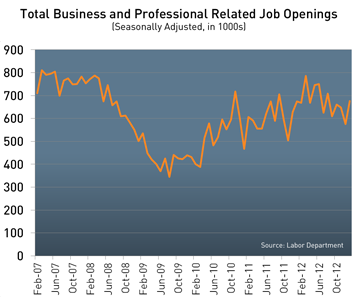
The highest job opening rate is in the professional and business sector where there is one job opening for every 27 workers currently employed, in contrast to one opening for every 33 healthcare workers or one for every 50 construction workers. Considering that the unemployment rate for management, professional and related occupation professionals is 3.8 percent, or one in 26, the sector is essentially near full employment.

"Maximizing your return on investment when it comes to professional talent today isn't a matter of how lean you can run the organization, but rather how effectively you are utilizing your top talent," notes Romaine. “This has been one of the largest shifts in talent demand this year. Managers aren't just looking at the capabilities they can add to their organization, but how to add talent that will let their talent reach their highest potential,” says Romaine.

While in a simple way this might mean freeing top producers of the responsibilities that distract from them doing what they do best, Romaine says it can also involve a more nuanced approach.

"A lone wolf could do amazing things, yet appear to be peaking in their performance. By bringing in someone on a similar level but with a different background, a manager can help to spark the rigorous debate and examination that allows a once plateaued performer to continue to grow and do their best work," says Romaine.

When talking about an organization's top performers, though, the conversation inevitably has to return to not just how to develop them, but how to retain them. A recent survey by the American Management Association showed that more than a third of employers are expecting turnover to increase in the coming year, while less than 20 percent of those employers feel they are well prepared for that turnover.

“Top talent is driven by success, their ability to have a positive impact on their organization, and the potential to continue to grow," says Romaine. "Building out teams that help top talent to grow is vital to increasing job satisfaction at a time when finding experienced replacements is becoming increasingly difficult. But helping your best people to work better also directly improves your return on human capital.”

Wednesday, March 20, 2013

Expectations of Optometrist/Ophthalmologist Associateships


Associateships begin and fail everyday. Why do they fail so often? A simple way to answer this is that either or both sides failed to meet expectations. More specifically, the expectations were never even laid out at the beginning, so one side was letting down the other and never knew why or that he/she was doing this.

Some common feedback I get from owners when I ask them about their previous associates is that it didn't work because the doctor could not produce enough, or the doctor did not want to buy-in, or the doctor needed more mentoring than owner was willing/able to give.

Upfront communication during the interview process could have helped a lot of associateships succeed better, or simply never start in the first place. It is better to find the right person rather than hire the wrong person and have to repeat the interviewing and onboarding process over and over again.

What the owner/practice should lay out upfront:

(simple examples, not comprehensive)

  1. Production goals

  2. Required schedule

  3. Transition plans

  4. Associate's leadership role in the practice in relation to staff

  5. Compensation

  6. Whether the associate will have any say so in equipment, office systems, and staff management

  7. Insurance accepted by the practice

  8. Particular cases or situations which must be handled by the owner

  9. What must be referred out

What the associate prospect should lay out upfront:

(simple examples, not comprehensive)

  1. Income goals

  2. Transition or practice ownership goals

  3. Skill sets

  4. Comfort level with various cases and patient types

  5. Length of time willing to commit to a practice/area

Remember not to rush into hiring an associate or becoming an associate when you still have a lot of questions or uncertainties.

Friday, March 8, 2013

Sequestration's Effect on Professional Employment

When the Bureau of Labor Statistics released its monthly employment report for January, it also released revisions to data for all of 2012, revisions that were remarkably more positive than what had been previously reported. In total, 647,000 more jobs were created in the United States last year than BLS reports had indicated. While that is only about 0.41 percent of total U.S. workforce, it significantly alters the estimate of year-over-year growth. As of January, before the adjustment, total employment year-over-year was up less than 1.2 percent. With the adjustment, average growth in 2012 grew to more than 1.5 percent, in line with the 40 year average, and well above the 20 year average of 1.1 percent annual growth. In fact, in the last 10 years employment has only grown an average of 0.3 percent per year. By these metrics, 2012 was at least an average year for employment growth and in recent history was actually above average.

This year, however, is already presenting new challenges and changing dynamics. The debt crisis in Europe has backed off from the cliff, putting a pin back in one of the largest potential economic grenades on the horizon. Yet, the cost-cutting effects from sequestration appear increasingly unavoidable and will in the coming months have measurable consequences across the military, military support, research, education and other sectors that rely heavily on government support.

While the cuts will have a rapid near-term effect on employment, they may also create a temporary talent acquisition opportunity for employers. Many of the positions affected are filled by highly trained people in disciplines that have continued to experience increasing talent shortages in recent years.

"In layoffs like these, that have nothing to do with job performance but rather fallout from much larger issues, highly qualified and capable people end up entering the job market," says Rob Romaine, president of MRINetwork. "It means a short window of availability for private sector employers to scoop up experienced professionals in disciplines like engineering, IT, accounting, and project management."

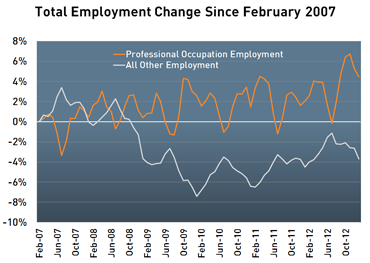
Total employment in the U.S. shrank by more than 6 percent during 2008 and 2009. Yet, despite comprising more than 20 percent of the U.S. workforce, employment of those in professional and related occupations remained essentially flat during those years and has since resumed its pace of growth.

“Historically, government layoffs in sectors like defense have had only a short-term impact on employment because the types of people who are laid off are inherently highly employable,” notes Romaine. “While these cuts will be reaching far beyond defense spending, the principle still applies for many of the industries that will be affected, which points to an opportunity for employers.”

This isn’t to say that sequestration will be a big boon for the U.S. economy. Many economists project sequestration will remove as much as 1.5 percent of GDP from the economy in 2013 and blame it for the sharp decline in GDP growth during the 4th quarter of 2012. Private-sector activity, however, is rebounding, and in the 4th quarter was enough to counter nearly a 15-percent drop in government expenditure and keep total GDP growth virtually flat.

“There was such a shortage of experienced talent before the recession that even with the sharpest economic decline in more than a generation, professional employment levels didn’t decline,” notes Romaine. “While the economy may slow again by the end of the year, we shouldn’t expect that to lower the demand for professional talent nor affect the availability of experienced professionals.”

Wednesday, March 6, 2013

Eye Care Staff-Making a Good First Impression


As a Staff Recruiter, I have the privilege of speaking to individuals around the country and at various points in their career.  It is my job to make a positive match, finding the perfect fit for both the candidate and the hiring practice.  However, after eight years in the recruiting field, I have learned that the best possible candidate is not always the most educated, experienced, or decorated within the field.  Sometimes, it just comes down personality and who makes the best impression.  I know that sounds trivial, but we are in the people business-ETS, as recruiters, and you, as an eye care professional-that being said, the old adage “You never get a second chance to make a first impression” really holds true.

Remember your phone screenings are part of the interview process; this holds true with your conversations with the recruiter and with the practice.  Give the phone call your undivided attention!  Move away from the screaming children.  Find a spot in the house with decent reception.  Sell yourself-elaborate on your resume!  Tell us why YOU are the candidate we have been looking for!  However, there is a fine line between confident and cocky, so don’t overdo it!

Also, early on in your search, take a look at how the outside world views you.  Google your name and see what “pops up”.  Those blog entries from high school may still be out there!  Take a minute to review your social networking sites-do you want your prospective employer to see what is posted?  You will also want to consider your phone’s ring back tone-my personal pet peeve.  Do you want their first impression of you to be a Nickelback or Buckcherry song?  I think not.  Also, listen to your voicemail!  When you are searching for a position, it is not the best time to place a commentary on last night’s game on your message nor is it professional to have a “You know what to do”  message-be professional.

Now is an exciting time to be a job seeker and the market only continues to get stronger.  It is time to put the years of education and preparation to work.  By putting your best foot forward, hopefully you will land that position you are looking for! 

Posted by Tiffany Worstell, Eye Care Staff Recruiter at ETS Vision. You can reach Tiffany at (540) 491-9112 or tworstell@etsvision.com.

Wednesday, February 20, 2013

Get Your Under-performing Employee to Quit-Try "Counseling Out"

What is Counseling Out?

Counseling Out is the process of providing enough regular, candid and honest feedback that an employee quits before being fired. Most managers wait too long to fire under-performing employees. It's better for the employee, manager, and company if the employee quits. If Counseling Out is done correctly, your problem employee will find a job and quit before you have to take action. There are usually two scenarios where counseling out can be used: 'Good Employee, Wrong Job' or 'Bad Employee, Really Trying'. Read two true counseling out stories at the end of this article.

Document Everything

Any time an employee may need to be fired, you need to document all communication. Regardless of how hard you try to help your employee or be nice, there is still the risk of a wrongful termination lawsuit. To protect yourself from wrongful termination lawsuits, you should implement some basic Human Resources' best practices. If you are unfamiliar with these practices, consult an attorney to learn how you can protect yourself.

4 Steps to Counseling Out

1.  Establish a Counseling Out Timeline

This first step to Counseling Out an employee is to establish your timeline. Four weeks is usually sufficient. Because you want the right people on your team, do not extend this process for months. When you decide that you are going to start, put an appointment in your calendar as your deadline. If he/she does not quit by your deadline, fire the under-performing employee.

2.  Start with Honest Feedback

It is usually easy to give positive feedback and bonuses, but difficult to cut someone's pay or give a bad review. Although it is sometimes easier to ignore a problem and hope it goes away, that is the wrong approach. Failing to give reviews, being falsely positive or giving undeserved bonuses leads to your team's failure. If you choose to counsel out an employee, honest reviews are vital. Start with an employee meeting to give honest feedback. Prepare a list of the problems with examples to help communicate the message. (For example: John Doe does not follow instructions - On April 15, 2006, John Doe was asked to do X. He did Y.) Be clear that this meeting is not his/her time to defend himself/herself.

This is your time to present all of the issues and let the employee know that the issues can not continue to exist. You may consider letting him/her schedule a meeting with you on the following day if the employee feels the need to explain or defend himself/herself. After you finish communicating your list, both you and your employee should sign and date the document of problems, indicating that it has been clearly communicated. If you believe there is a chance for improvement, you may choose to offer a performance improvement plan. Do not feel obligated to offer such a plan. There are some employees who are just not a good fit for a certain position. Finally, close this meeting with a clear statement like, "John, now would be a good time to start looking for another job."

3. Weekly Reviews

Schedule weekly meetings with your employee through the end of your Counseling Out Timeline. Be careful to not share your timeline with the employee, in case you decide that an earlier than planned dismissal is needed. Use these weekly meetings to make sure that he/she is still providing at least a neutral contribution to your company, and to inquire about the employee's job hunt. If the underperforming employee's attitude or performance is getting worse, point it out and make sure he/she understands that he/she still has a job to do. It is okay to encourage the employee in the job search, to ask what job search tools he/she is using, to offer your name as reference (if you have some positive things to say), and to ask if the employee has had any good leads or interviews. Remember to document any progress, the topics discussed at the weekly meeting, and to both sign a meeting summary before leaving the room.

4. Time's Up - Time to Fire the Underperforming Employee

Hopefully the employee finds a job before the end of your timeline; but if he/she has not, you need to deliver the news that the underperformer is fired. By this point, the employee should be on his/her way toward finding a new job and may already have interviews or a job offer. It is not usually appropriate to offer a 'layoff' or severance package to someone who has been Counseled Out. While it may feel good to do so, you have already given the person a working severance of sorts. Deliver the message, say goodbye, and thank the employee for his/her work.


True Story #1: Good Employee, Wrong Job

"A few years ago I had an employee who had gotten into a rut after four years in the same role. He and I candidly discussed the issues and determined that we needed to find him another opportunity. I talked to other managers, recommending him for a few open positions; and within a month he was on a new team. On that team, he has performed extremely well, is much happier, and is making a great contribution to the company."


True Story #2: Bad Employee, Really Trying

"Last year, I had an employee who was underperforming. I noticed the problem after only a month of employment. Because the job was difficult, I decided to keep encouraging and training, rather than making a quick dismissal. Although she was really trying, she had trouble getting the job done correctly and efficiently. After a few more months of problems, I decided to start four weeks of Counseling Out. She did not quit, but had interviews and good job leads by the time I fired her. Although she pretended to act surprised in our final meeting, she confirmed to former co-workers that she already had another job offer. I did everything possible to help this employee find a new job and felt good about the decisions."


This article is courtesy of Careerbuilder.com and was contributed by Tiffany Worstell, Vision Staff Recruiter-Nationwide.  To contact Tiffany, call (540) 491-9112, or email tworstell@etsvision.com.  To find out more visit www.etsvision.com.